How to Become a Sound Healer in Australia: Training, Certification and Pathway
If you feel drawn to working with sound and want to do it properly, the path is clearer than it first looks. This guide explains what recognition means in Australia, how ASHA's two training pathways compare, and the steps from enrolment to practising with confidence.
What "recognised" means in Australia
When we researched this, we found no nationally registered qualification in sound healing in Australia. You can check any course on training.gov.au. That makes the training you choose important. Clients, venues and insurers look for three things: structured training with real assessment, ethical and trauma-informed practice, and appropriate professional insurance.
ASHA (the Australian Sound Healers Association) builds its training around those three things, so you finish with a certification that reflects assessed practical skill, not just attendance.
Two ASHA training pathways
ASHA offers two online, part-time pathways. Both are trauma-informed and both lead to an ASHA certification.
Group Sound Healing Training
For people who want to lead sound baths and group sessions.
Modules 1–6A, about 150 hours over six months part-time.
Certificate for group facilitation.
Investment: $1,988 (paid in full).
See the Group Sound Healing Training
Advanced Practitioner Training
For people who want to work with groups and with individual clients.
Modules 1–10, 300 hours over 12 months part-time (around six hours a week).
Covers group facilitation plus one-to-one sound therapy sessions.
Investment: $2,997, or payment plans of 3 × $1,097 or 6 × $597.
See the Advanced Practitioner Training
If you already know you want to offer one-to-one sessions, start with the Advanced Practitioner Training. ASHA does not run a separate one-to-one course.
Step-by-step: from enrolment to practice
1. Choose your pathway and enrol
Pick the pathway that matches the work you want to do. Enrolment gives you access to the course online, so you can start learning from home.
2. Learn online, part-time
Work through the modules at a steady pace around your other commitments. Lessons cover sound and acoustics, the nervous system, instruments, session design, safety, ethics and scope of practice.
3. Join the monthly live sessions
Each month there is a live online Q&A with ASHA teachers. Bring your questions, hear from other students and get feedback on your progress.
4. Build your practical skills
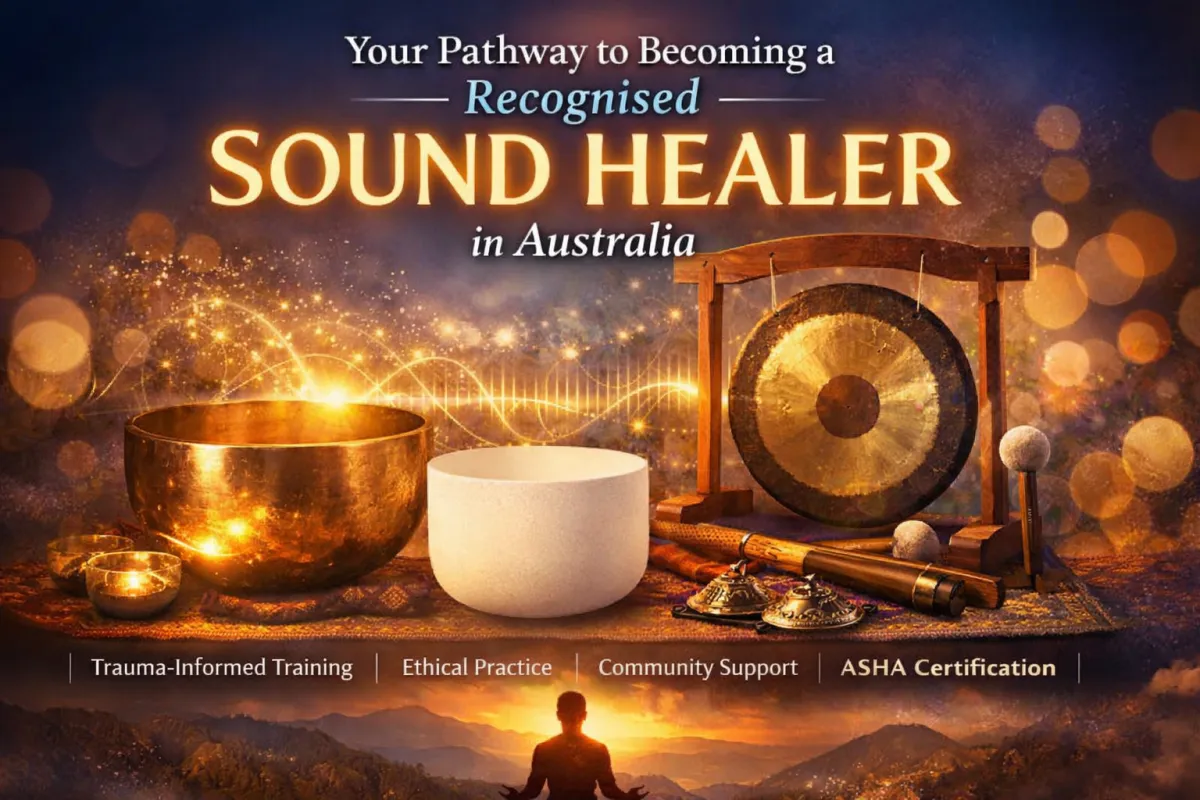
You practise with singing bowls, gongs, drums and other instruments, building toward full sessions. You don't need to buy instruments in your first three months.
5. Arrange student insurance before practising with the public
Before the practical module where you work with members of the public (Module 6A), you arrange student insurance through ASHA's insurance partner pathway. ASHA gives you the details you need to apply.
6. Complete your assessments
Assessment includes written work, case studies and a recorded sound bath. Your work is reviewed by ASHA's assessor before certification.
7. Certify and step into practice
Once certified, you can apply for professional indemnity and public liability cover through ASHA's partner pathway and begin offering sessions within your scope of practice.
Why trauma-informed training matters
Sound can bring up strong emotions. Trauma-informed training teaches you to screen clients, set up a safe space, work within your scope, know when to refer on, and close sessions with proper grounding. These are the skills that keep clients safe and give you confidence in the room.
Membership while you train and after you certify
Silver membership is included for 12 months when you enrol in ASHA training. It gives you the member badge, the ASHA community and eligibility for the insurance pathway. After that, Silver is $97 a year.
Gold membership ($197 a year, by application) adds a listing in the ASHA Practitioner Directory. To be listed you need recognised training, current professional indemnity and public liability insurance, and to be based in Australia.
Compare Silver and Gold membership
Common questions
Do I need to be musical?
No. The training teaches you how to play the instruments and how to structure a session. Steady, consistent playing matters more than musical background.
Can I really learn sound healing online?
Yes. Theory is delivered online, practical skills are built through guided practice and case studies, and the monthly live sessions keep you connected to teachers and other students.
How long does it take?
About six months part-time for Group Sound Healing Training and about 12 months part-time for the Advanced Practitioner Training.
What does it cost?
Group Sound Healing Training is $1,988. The Advanced Practitioner Training is $2,997, with payment plans available.
Your next step
If you're ready to train properly and practise with confidence, start by comparing the two pathways.
Explore the Advanced Practitioner Training · Explore the Group Sound Healing Training