Cultural Roots Of Sound Healing: Honouring Without Appropriating
The instruments on your mat did not begin with you. Sound practice carries lineages that stretch across cultures and millennia, and practising well means knowing where the work comes from, what belongs to whom, and how to honour that without pretending or taking. This is the grounded guide.
The Work Is Older Than The Industry
Modern sound healing can feel like a recent wellness invention, but the use of sound in ceremony, healing and contemplation is one of the oldest human practices we know of.
Vedic traditions in India developed chant and mantra as disciplined sound practice thousands of years ago. Buddhist and Himalayan cultures built bell, bowl and chant into monastic life. In ancient Greece, Pythagoras and his school explored music as medicine for body and soul. Across Africa, the Americas and the Pacific, drum, rattle and voice have carried ceremony for millennia.
And on this continent, Aboriginal and Torres Strait Islander peoples hold some of the oldest continuous sound traditions on earth, including the didgeridoo, or yidaki, which carries deep ceremonial significance and cultural protocols, including, in many nations, protocols around who may play it.
To practise sound healing in Australia is to work in a field fed by all of these rivers. That is a privilege, and privileges come with responsibilities.
Where Honouring Becomes Appropriating
The line is not always simple, but some markers are reliable.
Claiming a lineage you do not hold. Using words like shamanic, sacred ceremony, or ancient Tibetan technique as marketing garnish, without training in or connection to those traditions, borrows authority that is not yours.
Using culturally restricted instruments or practices. The clearest Australian example is the yidaki. Many Aboriginal nations hold protocols around its ceremonial use. A non-Indigenous practitioner using it as a session prop, without knowledge, permission or relationship, is not honouring the culture. Ask, learn, and when in doubt, leave it out.
Costume spirituality. Dressing a practice in another culture's imagery, dress or language to make it feel more mystical is decoration, not respect.
Erasing the source. Teaching or marketing techniques with no acknowledgement of where they come from quietly rewrites their history.
What Honouring Actually Looks Like
Name your sources. If your bowl technique comes through a Nepalese teacher, say so. If your practice is modern and eclectic, say that too. Honesty about lineage is itself a form of respect.
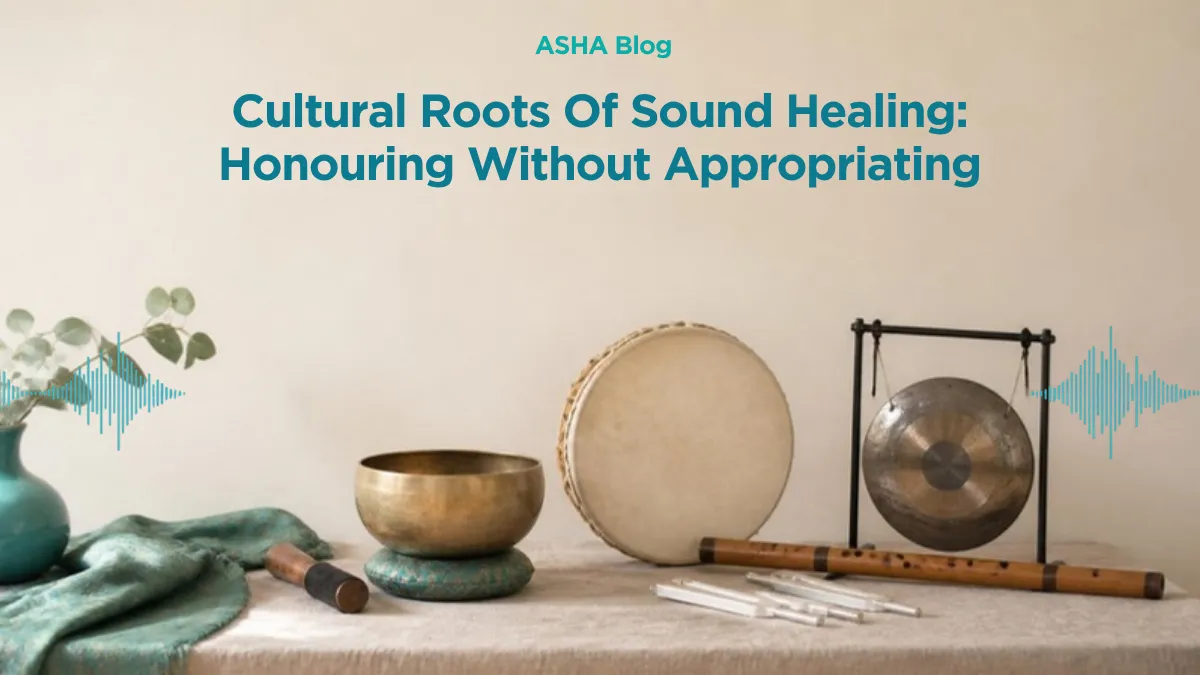
Learn the history of your instruments. Know what a Himalayan bowl is and is not, where crystal bowls actually come from (twentieth-century manufacturing, not ancient temples), and what the traditions you draw on actually taught.
Pay the traditions back. Learn from culture-holders where possible. Buy instruments from makers within the tradition. Credit teachers by name.
Stay in your own voice. You do not need borrowed mystique. A grounded Australian practitioner, honest about their training and respectful of their sources, is more credible than any costume.
Why This Is A Professional Standard, Not Just Good Manners
Cultural respect sits inside the same professional frame as consent, screening and scope of practice: it is about doing no harm, including harm to communities and cultures. It is written into ASHA's code of ethics because a field that wants to be taken seriously has to hold itself to standards on all of it, not just the clinical parts.
Practitioners trained to think this way stand out, to clients, to venues, and to the allied health world watching how this field conducts itself.
Train Into The Whole Standard
ASHA's practitioner training teaches sound work inside its full context: history and lineage, cultural respect, trauma-informed facilitation, ethics and scope of practice. That is what it takes to practise this work with integrity in Australia.