The Ethics Of Public Sound Healing Demonstrations
Public sound healing demonstrations look harmless. A gong in a shopping centre, a bowl circle at an expo, a taster session at a festival. But public demos skip the two things real sessions are built on: consent and screening. This is what ethical public practice actually looks like.
The Expo Problem
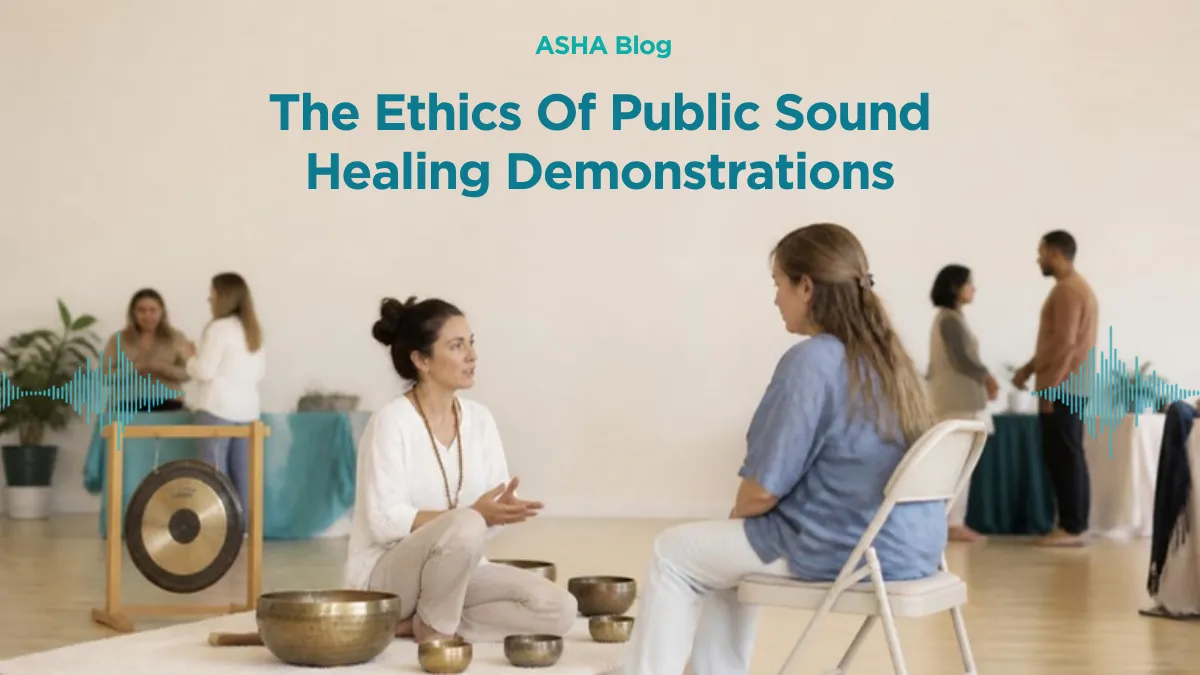
Picture the scene. A wellness expo, a busy walkway, and a sound healer offering five-minute taster sessions to whoever sits down. It looks generous, and usually it is meant generously.
But think about what is missing. Nobody has been asked about pacemakers, pregnancy, hearing devices, or trauma history. Nobody has consented to anything beyond sitting in a chair. The environment is loud, exposed, and impossible to control. And the person receiving the session may have no idea that sound work can move things in the body and the emotions.
In a private session, all of that is handled before a single note is played. In public, it is often skipped entirely. That gap is where the ethical risk lives.
Why Consent Is More Than A Yes
Informed consent means the person understands what the experience is, what it may bring up, and that they can stop at any time. A passer-by who sits down for a taster has agreed to be there. They have not necessarily been informed.
We who work with sound know that even a short session can surface emotion, memory, or a strong physical response. Most of the time it is simply pleasant. Sometimes it is not, and the practitioner has no idea who is carrying what.
Ethical public practice means building a genuine consent moment into even the shortest demonstration. A sentence or two. What this is, what it involves, what to do if anything feels uncomfortable. It takes thirty seconds and it changes everything about the exchange.
Screening Does Not Disappear Because You Are In Public
Contraindications do not care about the setting. Pacemakers, cochlear implants, neurostimulators, early pregnancy, recent surgery, and acute mental health episodes are all reasons to adapt or decline sound work, and none of them are visible from the outside.
A practical public screening approach looks like this: a small sign or card listing the key contraindications, a spoken check before the session starts, and instruments chosen for gentleness rather than intensity. Tuning forks off the body, softer bowls, shorter durations. Save the big gong wash for controlled environments.
The Environment Is Part Of The Ethics
In a treatment room you control volume, distance, and exit. In a public space you control almost nothing. Sound travels, and the person three metres away receiving your demonstration by accident never consented to anything at all.
This is not a reason to avoid public work. It is a reason to design it deliberately. Position speakers and instruments away from through-traffic. Keep volumes moderate. Choose instruments whose reach you can manage. A demonstration should land on the people who chose it, not the whole hall.
What Ethical Public Demonstrations Look Like
Done well, public sound work is one of the best introductions the field has. Here is the shape of doing it well.
Explain before you play. A short, plain-language introduction: what sound therapy is, what it is not, and what the next few minutes will involve.
Ask the screening questions. Every time, even when the queue is long. Especially when the queue is long.
Keep it gentle and short. Public tasters are an invitation, not a full session. Leave people curious rather than flooded.
Have an aftercare line ready. One sentence about drinking water, taking a quiet moment, and reaching out if anything feels unsettled, with a card or link for follow-up.
Know your referral edges. If someone discloses something outside your scope, the ethical move is a warm referral, not a longer demo.
Why This Standard Matters For The Whole Field
Sound healing is an unregulated field in Australia. That means every public demonstration is also a public statement about what this work is. When demos are casual about consent and screening, the field looks casual. When practitioners hold a professional standard in the most public settings, the field earns the credibility it deserves.
The practitioners who take this seriously are the ones venues rebook, allied professionals refer to, and clients trust with the deeper work.
You Do Not Have To Work This Out Alone
ASHA's 300-hour Advanced Practitioner Training is online, start anytime, and grounded in trauma-informed practice, ethics and scope. Graduates can apply for practitioner insurance through ASHA.