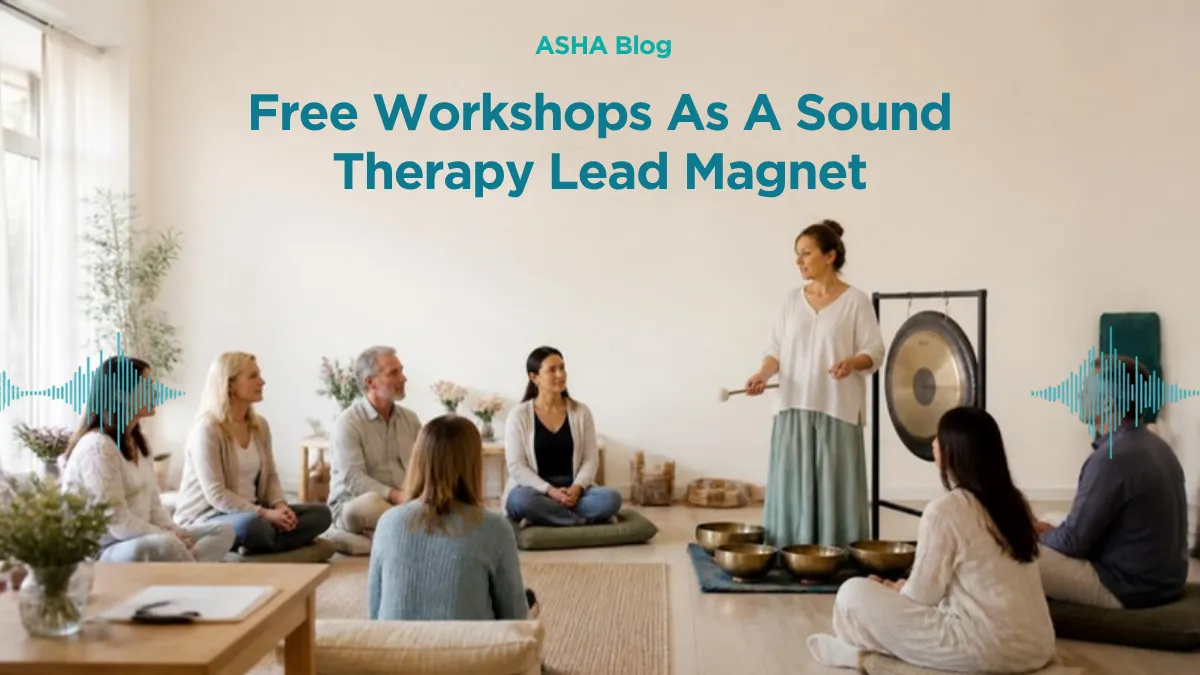
Free Workshops As A Sound Therapy Lead Magnet
Free feels dangerous when you are trying to build a paid practice. Will people just take the freebie and vanish? Sometimes. But run with structure, one free workshop a quarter can quietly become the most reliable client source you have. Here is the framework.
Why Free Workshops Feel Wrong
Most sound therapists resist free events for two understandable reasons. First, the fear of devaluing the work: if people can get it free, why would they pay? Second, the exhaustion of past experience: a free event that filled a room with freebie-hunters and produced not one booking.
Both concerns are real, and both are symptoms of the same problem: a free workshop without structure is a gift with no doorway. The fix is not charging. The fix is structure.
What A Free Workshop Is Actually For
A free sound workshop has one job: to let the right people experience what your work feels like, in a setting where the next step is obvious and easy. It is not a free version of your paid offering. It is a guided introduction with a beginning, a middle and a clear doorway at the end.
Sound therapy is uniquely suited to this. Nobody can read their way into knowing what a sound bath feels like. Fifteen minutes under real instruments does more convincing than a year of Instagram posts.
The Structure That Makes It Work
Cap the numbers and collect details. Free does not mean anonymous. Registration with name and email is the fair exchange, and a capped room (twelve to twenty) keeps the experience high quality and trauma-informed.
Open with three minutes of framing. Who you are, what sound therapy is and is not, what the next hour holds. This is where you quietly demonstrate professionalism: consent, contraindication check, permission to opt out of anything.
Deliver a real experience. Twenty to thirty minutes of actual sound work, gentle and well held. Do not water it down; do not give them everything. One clear taste, beautifully done.
Land it and open the doorway. After the return and a short integration, one honest paragraph: this is what I offer, this is what regular work looks like, and here is the workshop-only next step. A first-session voucher with a date limit, or a bring-a-friend rate. One offer, easy to take, easy to decline.
Follow up within 48 hours. One warm email: thank you, one aftercare note, the offer restated with its date, and a booking link. Then stop. No sequence of nudges. Trust the experience you gave them.
The Quarterly Rhythm
One free workshop a quarter is enough. It gives you four well-run events a year, keeps each one special, and builds a compounding email list of people who have felt the work. Between workshops, your monthly email keeps the relationship warm without selling.
Expect a familiar pattern: roughly a third of attendees book something within the offer window, another handful return months later, and the rest carry your name into conversations you will never see. All three outcomes grow a practice.
Protect The Economics
Free workshops work when they are rare, structured and aimed at your local paying audience. They stop working when free becomes your identity. Keep your paid offerings visible and priced with self-respect, and let the workshop be the doorway, not the destination.
Build Your Practice On Solid Ground
ASHA's 300-hour Advanced Practitioner Training is online, start anytime, and grounded in trauma-informed practice, ethics and scope. Graduates can apply for practitioner insurance through ASHA.