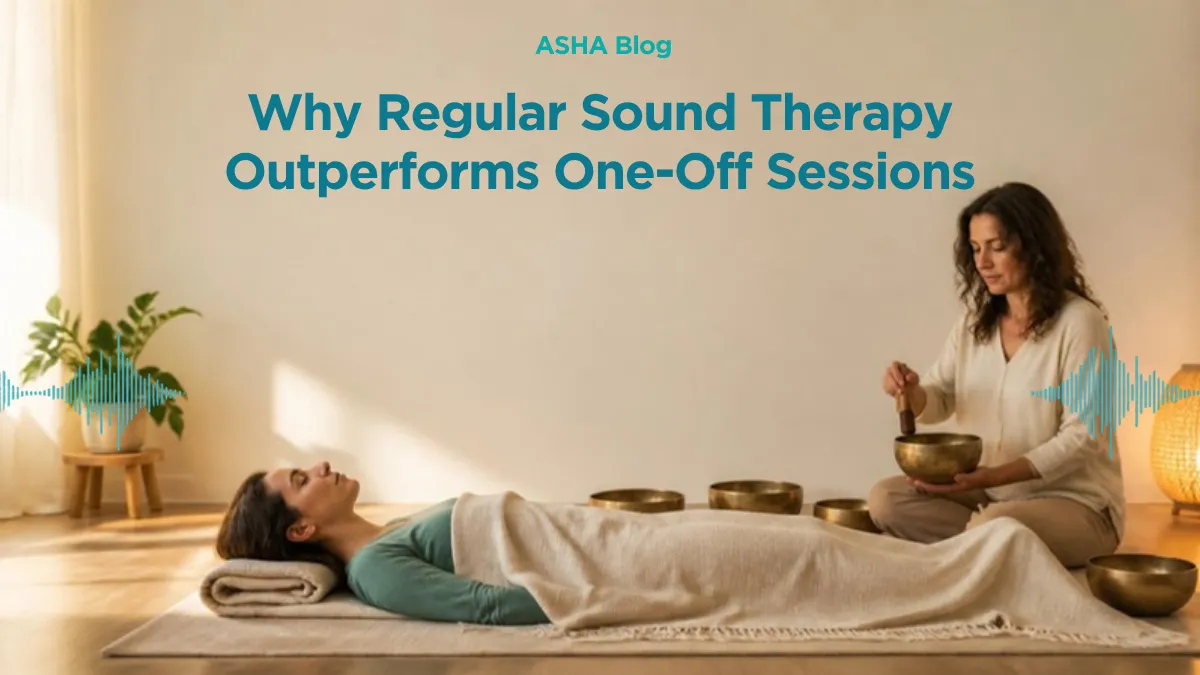
Why Regular Sound Therapy Outperforms One-Off Sessions
A single sound bath can settle your nervous system for an evening. A regular practice can begin to change how your nervous system responds to stress in the first place. The difference is not intensity. It is frequency.
The One-Off Experience
Most people meet sound therapy through a single session. A friend books them into a sound bath, or they try one at a retreat. They lie down, the gongs and bowls wash through the room, and they leave feeling calmer than they have felt in months.
Then life resumes. The commute, the inbox, the broken sleep. Within a few days the calm has faded, and the sound bath becomes a pleasant memory rather than a change.
Nothing failed there. A single session did exactly what a single session does: it gave the body a temporary experience of deep rest. The limitation is not the method. It is the dose.
What The Body Learns Through Repetition
The nervous system is shaped by repetition. This is true of stress, and it is true of recovery.
Every time a body drops into a parasympathetic state, heart rate slows, breathing deepens, and the vagus nerve gets a rehearsal in doing its job. One rehearsal is an experience. Weekly rehearsals over months are training. The research language for this is improved vagal tone and heart rate variability, and studies of repeated relaxation practices consistently point in the same direction: the benefits compound with regularity.
In plain terms, a body that regularly practises calm gets better at finding calm. The stress still arrives. The recovery gets faster.
Why Frequency Beats Intensity
There is a temptation, especially in wellness culture, to chase the big experience. The loudest gong, the longest session, the most dramatic release.
But the nervous system does not rewire through drama. It rewires through safe, repeated experience. A gentle fortnightly session over six months will generally do more for a person's baseline than one overwhelming immersion. This is the same principle behind physiotherapy, meditation, and strength training: consistency is the active ingredient.
For practitioners, this changes how you design offerings. For clients, it changes what to look for.
What A Regular Practice Looks Like
For general wellbeing: a session every two to four weeks is a realistic, sustainable rhythm, supported by short home practices in between. Even five minutes with a recording or a single bowl keeps the pathway warm.
For stress-heavy seasons: weekly sessions for six to eight weeks, then a review. This is the rhythm many practitioners use when a client arrives running on fumes.
For long-term integration: a monthly session as maintenance, the way people treat massage or supervision. Not a crisis response. A standing appointment with rest.
The Honest Caveats
Sound therapy is a complementary wellbeing practice, not a medical treatment. Many clients find regular sessions make it easier to rest and switch off, but regularity does not turn sound into a cure for diagnosed conditions. If a client needs clinical care, regular sound sessions sit alongside that care, never in place of it.
And regularity has to be trauma-informed. More frequent is only better when each session is safe, consensual and well paced for the person in front of you.
Want To Practise This Work Yourself?
ASHA's 300-hour Advanced Practitioner Training is online, start anytime, and grounded in trauma-informed practice, ethics and scope. Graduates can apply for practitioner insurance through ASHA.