Sound Therapy Contraindications Every Practitioner Should Screen For
Sound therapy is gentle, but gentle is not the same as universally suitable. A short screening conversation before every session is what separates professional practice from hopeful practice. Here is what to screen for, why, and how to do it without turning your intake into a medical exam.
Why Screening Is Non-Negotiable
Sound and vibration are real physical inputs. That is exactly why the work helps, and exactly why it needs the same respect as any physical modality. Most clients will have no relevant conditions. The screening exists for the ones who do, and you cannot tell by looking.
Screening also does quiet relational work: it tells the client, before a single note, that they are in the hands of someone who takes their safety seriously.
The Core Screening List
Pacemakers and implanted cardiac devices. Strong vibration close to the chest is the concern. Keep resonant instruments off and away from the torso, moderate the intensity, and when in doubt, ask the client to check with their cardiologist before on-body work.
Cochlear implants and hearing devices. Sound levels and frequencies land very differently through these devices, and what is pleasant acoustically can be harsh electronically. Invite the client to adjust or remove devices as they prefer, position them further from strong sources, and check in during the session.
Neurostimulators and implanted electronic devices (deep brain stimulators, spinal stimulators, insulin pumps). Same principle as pacemakers: keep vibration at a respectful distance from the device and stay conservative.
Pregnancy. Gentle, ambient sound is widely enjoyed in pregnancy, but keep strong vibration away from the abdomen, avoid on-body placement over the belly and lower back, and stay especially conservative in the first trimester. Comfort positioning matters as much as sound choices.
Seizure conditions. Ask about epilepsy and known triggers. Avoid sharp, sudden, strobing intensity of any kind and favour smooth, predictable soundscapes.
Acute mental health states. Psychosis, acute PTSD activation, severe dissociation: deep immersive sound can amplify rather than settle these states. This is referral territory, not adaptation territory.
Recent surgery or acute injury. No vibrating instruments on or near healing sites. Ambient sound at a distance is usually fine; on-body work waits for recovery.
Severe sound sensitivity, migraine, tinnitus. Not absolute exclusions, but dose matters enormously. Start quieter and shorter than you think, give the client control, and build only with feedback.
How To Screen Without Alarming Anyone
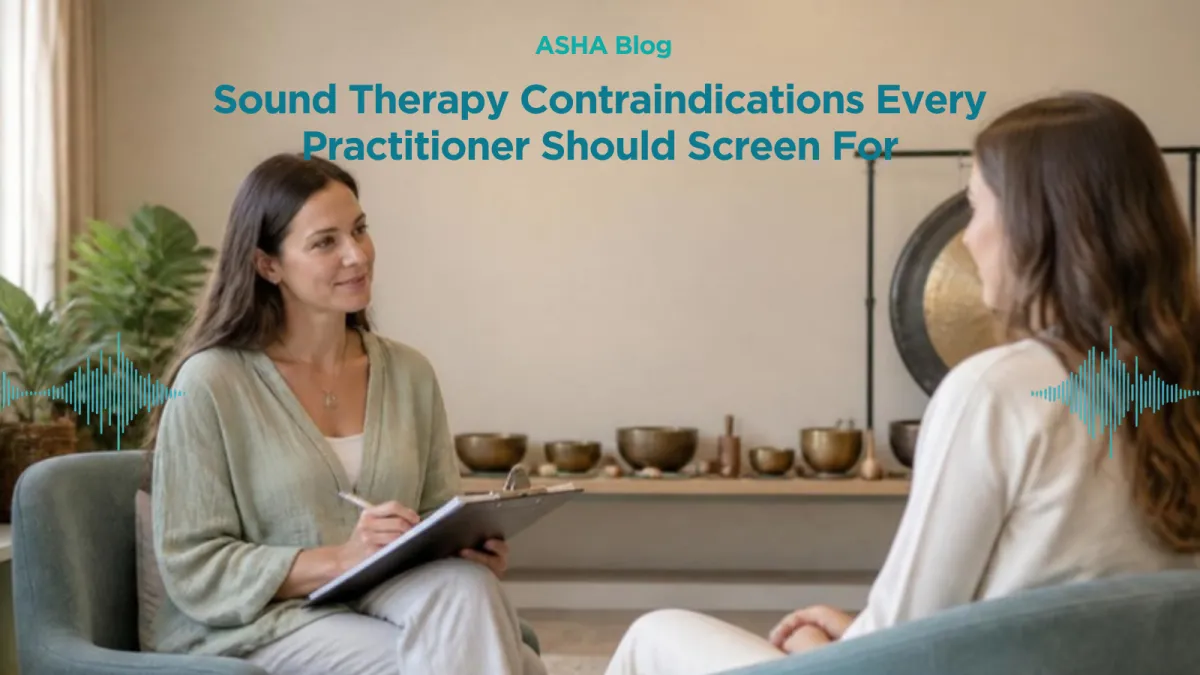
Three layers, all light-touch. A line on your booking form: any pacemaker or implanted device, pregnancy, seizure condition, recent surgery, or anything you would like me to know? A verbal check at the start of the first session, thirty seconds, normal tone. And an open door during the session: if anything feels too much, say so or raise a hand, and we adjust.
The framing sentence that keeps it warm: I ask everyone this, it just helps me tailor the session to you.
Adapt, Or Refer
Most flags mean adaptation: distance, volume, instrument choice, duration, positioning. Some mean referral: acute psychiatric states, unstable medical conditions, anything where you would be practising hope rather than skill. A warm referral to a GP or mental health professional is not a failure of sound therapy. It is sound therapy practised at professional standard.
Keep A Record
Note what was disclosed and what you adapted. It protects the client, informs your future sessions, and demonstrates professional practice if anyone ever asks. Screening, adaptation, documentation: that is the whole loop.
Learn The Full Framework
This article is the short version. The full screening, consent and adaptation framework, with forms and scripts, is part of ASHA's trauma-informed practitioner training.